

Tekmos Long Term Reliability Studies
Tekmos makes a wide variety of parts, and as a result, it can be complicated to compare reliability results over different parts. To address this, we incorporate a common reliability monitor into most of the parts we make. This monitor is designed to detect small changes over time due to the most common reliability problems. Specifically we are looking for threshold shifts due to either hot electron injection or DC bias. We detect the shift by measuring the frequency of an embedded ring oscillator. If a threshold shift occurs, the ring oscillator will change frequency, and that can be detected and measured.
We connect a number of individually addressable microcontrollers on a board. We then communicate with the board while it is in the oven, and have each processor measure the frequency of the various ring oscillators in the reliability monitor. The results are reported and stored on an external computer. This article will talk about two studies we are doing on our 0.6u process.
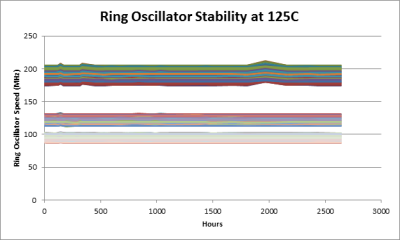
This is a plot showing the individual frequency measurements made on 3 sets of ring oscillators, in 77 devices, over 2500 hours and at 125C. The key thing to note is that after this time, there have been no long-term changes in the measurements.
There are times when all ring oscillators are running faster. This is because we share our ovens between reliability experiments and production dehydration bakes. Occasionally, our measurements coincide with the loading of the ovens with production material. When that happens, the oven temperature temporarily drops, and the lower temperature causes the ring oscillators to run faster.
The upper band of readings comes from a ring oscillator that is made from inverters. It is constantly running, and is looking for threshold shifts due to hot-electron injection. The middle and lower bands represent ring oscillators made of NAND and NOR gates, respectively. These ring oscillators are normally off, and are only turned on for measurement. Being off, they have a DC bias on their gates most of the time, and are used to look for threshold changes over time due to bias. This would measure the presence of contaminates in the oxide.
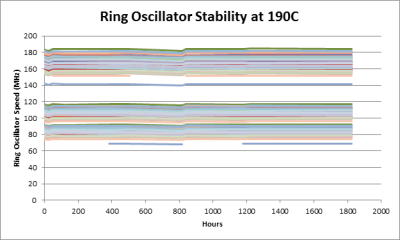
This plot shows the same information as the above plot, except that the oven temperature is 190C. We are doing the high temperature testing for down-hole applications in the oil industry that requires these temperatures. As a side benefit, the oil studies provide excellent qualification data for parts operating at lower temperatures.
All of the above reliability data are based on our 0.6u process. We use this process in our 68XX microcontrollers and in many military circuits. We also collect similar data for our 0.35u and our 1.0u SOI processes. While many reliability experiments run for only 1000 hours, we plan to continue collecting data this type of data for at least a year (8000 hours), and perhaps longer, depending on the availability of oven space.
Date
2014-09-01

Wafers Edge Blog
Main Office
Tekmos, Inc.
14121 Highway 290 West
Building #15
Austin, TX 78737
Phone: (512) 342-9871